The Myers-Briggs Personality Type of Ludwig Van Beethoven
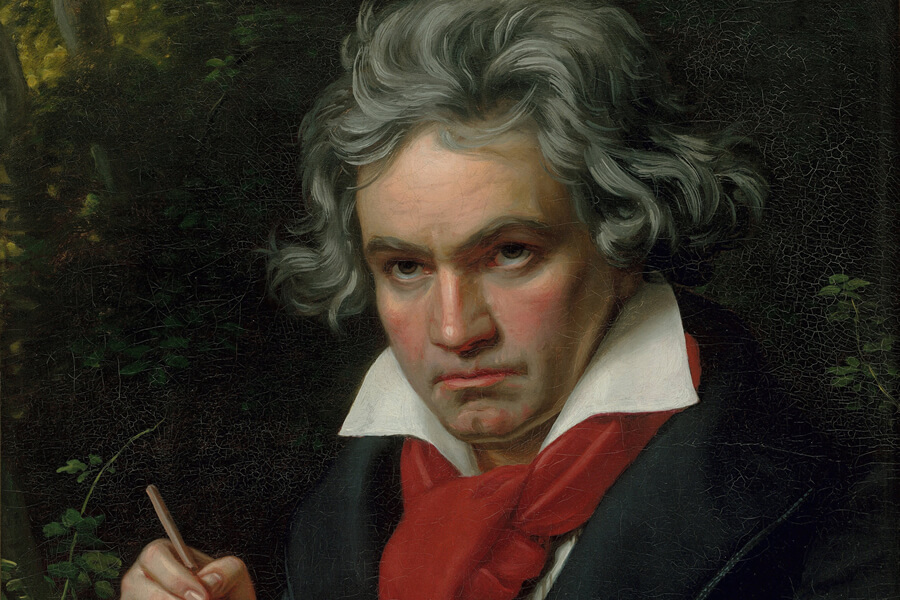
As with my analysis on Mozart, I walked into this analysis on Beethoven with a couple of different personality types in mind…only to land on something completely different. Since Beethoven’s personality type is fairly controversial, I’ll step you through my logic, so you can understand exactly how I reached the conclusion that I did. As per usual, I’ll list my sources at the bottom of the article. For Beethoven, I read the better part of a biography, and various articles online. (I pull from multiple sources to avoid author bias, or personality bleed.)
The most prominent theory for Beethoven is INTJ, and it’s understandable. After hearing a little about his temperament, I was inclined to assume NTJ. However, after studying Beethoven more in-depth, I realize now that my initial impression was hasty and born out of ignorance. So, I’m going to start by addressing his judging axis, or more specifically, why his Fi is higher than his Te. (There is no sign of the Ti/Fe axis in this man.)
Beethoven, the INTJ?
Beethoven is known for his arrogance, aggression, stubbornness, and individualistic nature. He endlessly refined his work, and was extremely precise in how he wanted it performed. Beethoven was also a loner, and extremely difficult to work with. During some of his concert preparations, the players would literally refuse to allow him in the same room with them during their rehearsals. There was definitely a controlling nature about him, which is common for TJs. To be honest, the initial impression Ryan and I got of Beethoven after just a shallow, cursory look into him made us consider ENTJ, because the Te/Fi axis seemed imbalanced. However, none of the things I just mentioned are specific to TJs. (And, for the record, being hardworking, focused, and successful isn’t inherently TJ either, just like being brilliant isn’t inherently INTJ.)
Given a closer look, I think his Te makes more sense as a lower function, as the explosive nature of Te comes out when his identity function is triggered in some way, which we’ll talk about after a closer look at Beethoven’s Te.
Where is Beethoven’s Extraverted Thinking (Te)?
Te in an individual surfaces as being structured and regimented, especially in regards to one’s goal, but many also want physical order in the environment around them. TJs are planners and optimizers. In addition, TJs pay attention to the external systems, the infrastructure already in place in the world. They take advantage of these systems, as well as using them as an objective metric to determine success. (I think the stereotype of what an INTJ looks like often gets skewed by the mistyped INTPs amongst their ranks.)
I don’t see any of these inclinations in Beethoven. Beethoven was known for a lack of sophistication and refinement, and his notoriously unkept appearance. Bear in mind, he wasn’t born a noble, but he makes no attempt to change anything about himself or adapt at least a little bit in order to fit into the world around him and be more successful. This indicates inferior extraverted judging (Fe or Te). In addition, his living spaces were always extremely chaotic, both messy and disorganized. Of course, TJs don’t have to be perfectly tidy, but being extreme in the opposite direction indicates not having high Te, as high Te users value some level of order in their environment. Apparently, Beethoven was also confused about his age for much of his life. He was convinced he was born in 1772 based on what he thought his age was even though it made no sense given when his grandfather died. This looks like a devaluing of objective logic (Te).
Beethoven also lacked a business mentality. He had to be pushed to tutor others, and would only do so willingly when it was a girl he’d taken interest in. In addition, he was extremely resistant to altering his work or accepting any kind of criticism to make it more successful. Of course, most of what he created (and drew from within himself) was successful, but for instance, his one and only opera ever written was not successful when it was first published. In spite of this, he fought vehemently to keep it as it was, refusing to change a single note. It ended up being a flop. Several years later, he released an improved version of the same opera that did better, but he never wrote another opera again.
A Quick Note About Fe
To give a quick note about Fe, Beethoven paid no attention to social graces, often clashing with those around him, which strongly indicates a lack of Fe in any position, especially given the era. There’s no inclination towards harmony, beyond his meager attempts to restore his friendships after one of his characteristic explosions.
Now, Let’s Talk about Beethoven’s Fi
“Prince, what you are, you are by accident of birth. What I am, I am through myself. There have been and will always be thousands of princes. There is only one Beethoven.”
Beethoven’s music is known for being highly personal, reflecting his current emotional state and his life. The book I read described his music as his autobiography. One might argue that of course that’s true for any artist or musician, but that’s actually not true. For example, Mozart’s music was actually completely disconnected from his life circumstances and current state. Mozart wrote in a way that appealed to everyone. Beethoven was much more specific than that. During the time Beethoven lived in, the expectation was to write in a way that appealed to everyone (befitting of Fe). Whereas, Beethoven played a major role in ushering in the Romantic Era, by deviating from the norm of the Classical Era, and focusing on emotional depth and self-expression (Fi).
“I do not write for the multitude–I write for the cultured!”
Beethoven wrote one opera during his lifetime. When it was initially performed, it was not very popular. His performances had very few ordinary people in attendance, and he was criticized for his work not appealing to ordinary people. Beethoven was rather offended by this, especially when compared to Mozart’s success in appealing to ordinary people. His response was to demand his score back, and stormed out, after saying, “I do not write for the multitude–I write for the cultured!” This demonstrates Fi’s more personalized, subjective focus.
“Is he then, too, nothing more than an ordinary human being? Now he, too, will trample on all the rights of man, and just satisfy his own ambition. He will exalt himself above all others and become a tyrant!” – Beethoven
Beethoven was prone to idealism, whether that be someone who was close to him like his grandfather or a prominent figure he greatly esteemed, such as Napoleon Bonaparte. A friend of Beethoven, Ferdinand Ries, said that Beethoven considered Napoleon as great as the greatest consuls of ancient Rome. Beethoven openly spoke of the events happening in France, and proclaimed his intent to move to Paris permanently. During this period, he was working on a new symphony, Eroica, which was found with Napoleon’s name written at the top of the title page. It was believed that Beethoven wrote it with Napoleon in mind, and may have intended to send Napoleon a copy. However, when Napoleon declared himself Emperor of France, Beethoven flew into a fit of rage, his ideals shattered.
“Since not only do I understand nothing whatsoever about such matters, but also such matters are profoundly distasteful to me.” – Beethoven
Beethoven had very strong opinions on things. He rarely comes across as detached, apathetic, or logically critical. He was also offended very easily, and didn’t take criticism well. It was common for him to fly into a rage over something fairly minor, and then have to apologize later. Of course, his behavior in particular is admittedly extreme, and not what I’d consider healthy, but it is not at all fitting for an ITJ type, as they are usually very self-contained and reserved.
In addition to this, Beethoven has been shown to suddenly turn on someone over a slight offense, which offended his values. For instance, Beethoven spent time playing with a violinist named George Bridgetower, whom he was rather enamored with. Bridgetower’s skill allowed him to keep up with Beethoven’s piano playing, and play Beethoven’s compositions flawlessly. Beethoven was astonished and thrilled. Their coordination led to such a triumphant performance that Beethoven immediately dedicated the sonata they had finished playing to Bridgetower. Unfortunately, later that night, Beethoven heard Bridgetower make an off-color remark about a lady. Beethoven was so utterly appalled that he withdrew the dedication and refused to reconsider. Of course, this remark and Bridgetower’s skill in playing had nothing to do with each other, but Beethoven refused to dedicate any of his work to someone who’s character he didn’t approve of.
To give one more quick example, Beethoven once fired a cook for lying because “Anyone who tells a lie has not a pure heart and cannot make a good soup.”
“There never was a time when Beethoven was not in love, and that in the highest degree.” – Wegeler, a friend of Beethoven
“He often fell in love, but usually only for a short time. When once I teased him about his conquest of a certain beautiful lady, he confessed that she had captivated him more intensely and longer than any other — seven whole months.” – Ferdinand Ries
Beethoven was a hopeless romantic. From my reading, it seems like there was rarely a time when he wasn’t in love with someone, although most of the time that love was unrequited. (It seems he often fell in love with women who were unavailable in some way.) Of course, any personality type can fall in love, but it seemed to be a prominent theme for Beethoven. He’d fall hard and fast, have his heart broken, and then fairly quickly find someone else. This style of emotional impulse and general focus on finding love is more common for FPs than thinker types, due to an FP’s focus on their feelings.
Extraverted Perceiving Evidence for Beethoven
Now that I’ve established that Beethoven is most likely an Fi dominant (although I’m sure there are still some diehard INTJers who vehemently disagree with me, let’s starting looking at evidence for his perceiving axis. Although, first I’d like to cover a quick point that specifically supports him being a perceiver, rather than a judger. This is particularily important because INTJs, as inferior extraverted perceivers, will be one of the least spontaneous and more structured types that there. In other words, they’re (next to the ISTJ) the least perceiver-like. That might be hard to believe because so many mistypes out there have confused what INTJs really look like.
1. Beethoven and his last minute tendencies
Beethoven worked on his composition up until the very last minute, often making major changes only a few hours before rehearsal. In one instance, he added an entirely new trombone instrumental section, finishing it around 5am in the morning, with rehearsal scheduled for 8am. They had very little time to find trombonists (especially considering the hour), and there wasn’t enough time for the copyists to write out the parts. Rehearsal went terribly. The official concert was happening that evening, at 6pm. Several pieces had to be omitted, and the person turning the pages for Beethoven (as he played the piano) had to rely on secret glances from Beethoven because Beethoven hadn’t had time to write all his music out in a readable fashion.
2. Beethoven never learned from these mistakes
A few weeks later, Beethoven was putting on another event. Beethoven didn’t stray from his last minute preparation tendencies, which stressed out the violinist he was coordinating with. Being warned of the way Beethoven was, the violinist kept pressuring Beethoven and checking in on him, so he could get his part early enough to practice it sufficiently. Beethoven worked up until the event, didn’t have enough time to copy everything out clearly, and the violinist literally stood over Beethoven, rehearsing as he composed.
3. Beethoven frequently changed residences
He would sometimes even rent multiple places at once, which could suggest a continual need for variety or a change in scenery. This sounds like a higher extraverted perceiving function.
Bad Evidence for Beethoven’s Perceiving Axis
I’ve seen Beethoven’s physicality or forcefulness attributed to Se. (On that note, I saw someone try to argue that his drinking habit was an indication of inferior Se, which is utterly ridiculous. Being an alcoholic in no way ties specifically to inferior Se, or Se generally speaking.) I’ve also seen people argue that his musical style is more singular like Ni, rather than being varied or wild. The problem with this is that auxiliary Ne, in service to a dominant introverted function, will not be as varied.
Someone might also be tempted to attribute his absentmindedness and his clumsiness to being an intuitive. He was known for being accidentally destructive, destroying furniture and knocking things over mid-concert. But this all could simply be his introversion coupled with genius. (Geniuses tend to be hyper-focused on their trade, detaching them from reality and creating deficits in other areas of their life.)
So, is Beethoven an INFP or an ISFP?
Beethoven’s sketchbooks were what helped me finally settle. The way Beethoven approached his composition process was distinct from those before, which is important to pay attention to. Because, most people do what everyone else does, so following a common process is not always good evidence for any function in particular. But, deviations from the norm can provide valuable insights into someone’s personality. Beethoven did not initially compose on large formal sheets as was typical for the time. He used small notebooks, which allowed him to jot down his ideas as quickly as they came to him. In addition, he had a vast amount of rough drafts and sketching for each work, a large number of which have survived (about 10,000). The amount and depth of iterations that he sketched out make it possible to trace each composition back to it’s infancy. (Remember, the key here is that this was not normal or expected for that time.) This level of detail does not sound consistent with an Ni user, who prefers to spend a long time mulling over their ideas and mentally refining them before putting them down on paper or sharing them with others. He would also check all of his published works, and send corrections for every tiny error. This demonstrates an individual who is very meticulous.
In addition, Beethoven’s sketchbooks were not limited to his musical compositions, but they were also filled with thoughts, reflections, and daily life musings. According to one source, “Beethoven’s tumultuous relationship with his family, his hearing loss, and his philosophical introspections all found a voice in the margins of his sketchbooks. These notes offer a unique aspect that underscores the inextricable link between Beethoven’s personal life and his work, further enriching the narrative of each composition.” This not only further supports Fi dominance, but to me, sounds like the wandering mind of an NP. He wasn’t separating his musical work from his journaling. Everything was intertwined.
Lastly, Beethoven had some hyper-specific habits that sound like Si, or more specifically lower Si due to their scale. For instance, he was very particular about his food, but very irregular in his eating habits (often skipping meals). One example is a bread pudding soup that he ate on Thursdays with 10 eggs on a separate plate. He carefully examined each egg, breaking them and sniffing them before stirring them in. As another example, for his coffee, he’d personally count out exactly 60 coffee beans because he felt that made the perfect cup of coffee.
In Summary…
I probably could have read another book and found more evidence, but I’m slow enough as it is in getting these articles out. Overall, I think there is a very strong case that Beethoven is an IXFP, and that the evidence suggests INFP specifically. Feel free to share your thoughts in the comments!
References
https://nac-cna.ca/en/stories/story/beethovens-complete-heiligenstadt-testament
https://www.wrti.org/arts-desk/2020-12-15/these-are-the-quirks-about-beethoven-you-may-not-know
https://popularbeethoven.substack.com/p/beethovens-habits-and-relationships
https://www.worldhistory.org/Ludwig_van_Beethoven/
https://lvbeethoven.com/beethovens-sketchbooks-a-glimpse-into-a-geniuss-mind/
https://lvbeethoven.com/beethovens-sketchbooks-what-they-tell-us-about-his-creative-process/

Hi there! If you enjoyed that article, leave us a quick comment to encourage us to keep writing, and check out our Updates and Current Projects. In addition, if you've found our content helpful, please consider Buying Us A Coffee to help keep this website running. Thank you!
This dude reminds me of Miyazaki Hayao lmao
I remember this guy being typed by some as ISFP rather than INTJ.
I saw that theory a few times
I have three questions.
1. When I see his specific traits, I confuse between 3rd si and inferior si. How would inferior si manifest?
2. How does Se manifest when coming up with ideas? Weren’t his diary and creative work interconnected?
3. Are Infp tending to be more meticulous than isfps?
His idealization of certain people and condemning (hope that doesn’t sound too harsh) of others kind of reminds me of my INTJ friend’s INFP sister and how she talks about certain K-POP Idols/groups.
Like they’re both really into PLAVE right now and they both gush about how talented all the members are all the time. But they were talking about the 10th anniversary of another group and the INFP is more of a fan than the INTJ so she (the INTJ) mostly just listened to her talking about her experiences, but one member of the group did something controversial/insensitive lately and while she acknowledged his accomplishments she didn’t “hype him up” like she did the other members. I guess she made comments while talking about him early on, like saying “…but he got better… butthenhegotworseagain” that last part added on really quickly. And she was talking about how his morals/beliefs might be messed up/wrong or he’s just ignorant and the INTJ sister added to it, asking if there’s much of a difference either way (Implying being that ignorant about what he did is practically the same, I think?) and I don’t think she… disagreed? I still don’t think I understand Fi 100% but I think listening to conversations like this helps me a bit, haha.
They’re BOTH also pretty blunt about their feelings/views on something and whether they care/are emotionally connected to it or not. INFP sister may be slightly less so than the INTJ most of the time, but if it’s something like a group she really likes getting disbanded due to unpopularity she can get pretty dramatic/explosive and wonder why people didn’t listen to them, almost making you feel like your failed her in some way, haha.