The Myers-Briggs Personality Type of Magnus Carlsen
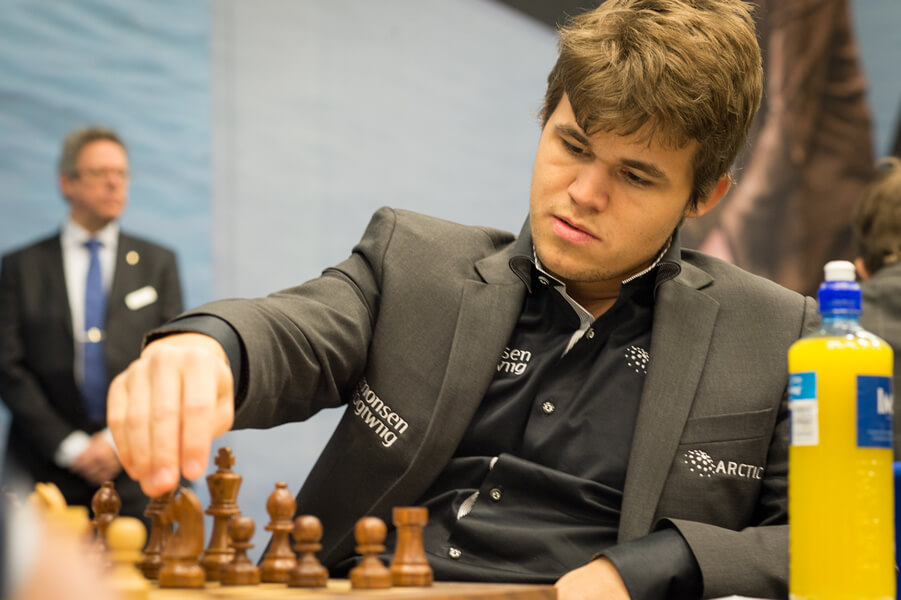
A month ago, we received a paid request to analyze the personality type of Magnus Carlsen (who’s typically identified as an ISTP). Magnus Carlsen is definitely a break from the norm for us. Typically, we stick with historical figures, because you can see their entire character arc, so to speak. The book is closed, and you have all the information. So, analyzing the personality type of Magnus Carlsen was a little bit out of my comfort zone, but there seemed to be a lot of information out there on him so I went ahead and bit the bullet, so to speak. I don’t regret it.
Magnus Carlsen was definitely an interesting subject to study. (I know I keep saying this but studying real people is far more interesting than fictional characters.) Of course, as per usual, I made sure to check out popular opinion on his personality type, and get a general idea of the competing theories. (I typically do this after I‘ve started to form my own theory in order to avoid bias, but in this particular instance, I had already heard that the popular theory on Magnus Carlsen is ISTP.) Since Magnus Carlsen is fairly young, I relied primarily on YouTube interviews and documentaries, rather than book sources. I’ll include links at the bottom of this page, but I did watch A LOT, so I may limit it to the ones that I felt were the most useful.
As per usual for strategic individuals, the debate surrounding Magnus Carlsen’s Myers-Briggs personality type centers around the IXTX types, with ISTJ being excluded from the contest. In other words, INTJ, ISTP, and INTP are the three personality types in question, with ISTP surprisingly being the most prominent. (I mostly say that because INTJ seems to be the default assumption for chess players, given the mastermind stereotype.) So with that in mind, I think I’ll start by sharing my observations regarding which thinking function Magnus Carlsen uses. Regardless of whether or not you agree with me, I hope you find this analysis interesting!
Does Magnus Carlsen Use Introverted Thinking (Ti) or Extraverted Thinking (Te)?
A significant difference between Te and Ti is that Te aligns itself with externally recognized or verifiable methods to achieve success. Essentially, as a function that values efficiency, Te takes advantage of the collective knowledge or tools already out in the world, and jumps into action. These types approach life in a structured way. Magnus Carlsen sounds like the complete opposite.
1. Magnus Carlsen Does Things In An Unstructured “Lazy” Way
“The most important thing that I’ve done is that I haven’t really listened to people who want me to do things like a certain way because that’s the way things have always been done, especially with the Soviet chess school that was the dominant one for so many years. So, I’ve always sort of gone my own way, try to have as much fun. Everything has to be about enjoyment. And yeah, I cannot tell you why, but I just like understand the game better than the others…” – Magnus Carlsen
“I don’t do much serious work on my own.” – Magnus Carlsen
“He listens to himself and only himself. It’s his opinion that he trusts and values.” – Carlsen’s Wife
Ti users (or TPs) have an innate need to ignore what’s been already figured out in the external world, and figure things out for themselves. This oftentimes means they forgo a structured “efficient” approach in favor of doing things their own way. That’s what Magnus Carlsen seems to express. He claims to be known in the chess world for being a little bit lazy, because he doesn’t treat chess like a job. He thinks about it all the time, but doesn’t adhere to any kind of strict schedule for training, practicing, and etc. (As a kid, he enjoyed lessons until he was given homework.) In an interview, Magnus says that he doesn’t believe in studying by the book. (He later tells the person to study openings and tactics, so there’s obviously a balance a minimum amount that’s absolutely required.)
To give a fairly concrete example, apparently, Garry Kasparov offered to train Magnus Carlsen after their famous match in 2004. However, Magnus rejected his offer because Kasparov wanted to be able to control what games he played in and what openings he used. This ran contrary to Magnus Carlsen’s desire to have the freedom to experiment.
I noticed a ISFP theory on Magnus Carlsen, which wasn’t unreasonable, but as inferior Te users, oftentimes these types struggle with structure but are drawn to it. Structure often helps ISFPs excel, which means in a situation such as Magnus Carlsen’s, I’d expect an ISFP to be more willing to take advantage of external help and methods. FPs can really buckle down and start looking like TJs when the situation demands it. I’m not seeing signs of that with Magnus Carlsen.
2. Magnus Carlsen Has An Individualistic Perspective
“I found it hard to give great advice because you don’t know what is going to work for everybody.” – Magnus Carlsen
In the interview that the above quote was taken from, Magnus Carlsen was asked about a conversation he had had with a chess candidate. The chess candidate had asked him for advice, which apparently Magnus Carlsen struggled to give. The reasoning here supports him not having Te, because of what I explained about Te earlier. TJs typically have a more universal approach to stuff like this, in the sense that they recognize one “best” or most efficient way to something; and as such, they believe that everyone should adhere to it. (This is why they are often described as being absolute, or having black-and-white thinking.) However, Magnus Carlsen expresses a more individualistic approach, because different things work for different people. Similarly, in another interview, when asked to give a piece of advice, he says that his advice is to not listen to advice. This could potentially be evidence for an inferior extraverted judging function (Fe or Te) as well, because he seems to be pushing back against externally available knowledge, prioritizing independent thinking and decision-making.
3. Magnus Carlsen Is Terrible At Planning
“Me being late is down to a couple of things. First, I hate waiting, but also… I’m terrible at planning.” – Magnus Carlsen
A general tendency amongst TJs, is that they’re good at calculating time cost because they’re attuned to external cause and effect. That’s due to Te being thinking that’s focused on the external world. Magnus Carlsen, however, in spite of being late time and time again, doesn’t make (or fails to make) adjustments to change that. In the quote above, he explains that it’s partly because he’s terrible at planning. I’m certainly not saying that a TJ will never be late, but typically TJs are rather good at planning. They’re not usually people who constantly run late.
Magnus Carlsen Is A Perceiver
“You don’t have to hate fun. You can embrace it sometimes.” – Magnus Carlsen
For the record, the Judging/Perceiving is the most unreliable dichotomy in the 16 personalities theory. However, there are some general patterns that can be observed in perceivers and judgers. Some people seem so obviously perciever, while others seem so obviously judgers. And then of course there are the people that walk the line between the two. Magnus Carlsen immediately strikes like a perceiver. In the next section, I am going to delve specifically into the evidence for his perceiving functions, but in this section, I want to address some general perceiver evidence that could indicate either Ne or Se, that wasn’t covered in the above section as anti-Te.
1. Magnus Carlsen expresses an open-ended outlook towards the future.
“I’m not going to rule out anything.” – Magnus Carlsen
Even when making decisions (such as to not defend his World Chess Champion title, he always makes sure to say that anything could happen in the future. He has this attitude about a variety of subjects, not just the World Chess Championship. Typically, in any interview I watched, whenever the future was brought up, if he indulged the question, Magnus Carlsen always made statements to the effect of “nothing is set in stone.”
2. Magnus Carlsen Is More Focused On The Journey Than The Result
“People ask what my goal is. I don’t have a goal.” – Magnus Carlsen
“For me, it’s not so much about reaching the goal. It’s about having a goal…” – Magnus Carlsen
“I think that conclusions shouldn’t necessarily be based on the result. It should be whether you’ve made a good decision or not.” – Magnus Carlsen
To be honest, I initially wasn’t sure if I wasn’t going to talk about this here, or use it as anti-Te evidence in the Ti vs. Te section. After all, Te is a very goal-oriented, or results-oriented function. However, the introverted perceiving functions (Ni and Si) can encourage the forming of goals because they’re concerned with future projection. However, either way, we see that Magnus Carlsen is not very concerned with goals. Sure, he had an initial goal to be the top chess player in the world, but any personality type can have a goal. A distinction between perceivers and judgers is that judgers, on average, form goals to achieve goals. Judgers desire closure. It’s about reaching the goal for them. Percievers, on average, are more about the journey. The goal just gives them a direction to go, or a purpose. Percievers are more likely to see goals as optional, or highly subject to change.
3. Magnus Carlsen prefers Blitz and Freestyle chess
Both of these styles of chess rely on adaptability and quick-thinking. Of course, Blitz is fast-paced, meaning that reaction speed is critical. Freestyle chess, on the other hand, is a break from the standard chess format, having the back row randomized. This eliminates the ability to calculate out every possibility ahead of time or memorize strategies in advance, instead emphasizing in-game thinking and strategizing. These are precisely the forms of chess I’d expect a perceiver to prefer.
As An Intuitive Player, Does Magnus Have To Be An Intuitive In Myers-Briggs?
“I often take decisions based on intuition. My intuition is often based on a sense that something is there… I think that I probably sacrifice a lot of pawns due to intuition.” – Magnus
Magnus Carlsen is known for being an “intuitive” chess player. Naturally, it’s easy to make the assumption this also means he has to be an intuitive in Myers-Briggs, but that’s not necessarily true. The word “intuition” has different contexts and meanings. In this particular case, an intuitive chess player seems to be one that relies on instincts, rather than conscious calculations. So, an ISTP, for instance, would make perfect sense as an intuitive player, because SPs often rely on their instincts.
So, Which Perceiving Axis Does Magnus Carlsen Use?
Below, I’m going to share specific perceiving related observations that I made and what I think they mean.
1. Magnus Carlsen’s Intuitive Process Seems To Be Subconscious
“Honestly, when I’m feeling good I don’t think about these things. It’s just a state of flow… where I know how much risk to take.” – Magnus Carlsen
“You can just feel it when your intuition doesn’t work. Um, it’s like you cannot speak the language anymore. You used to be fluent and now you cannot find the words.” – Magnus Carlsen
Typically, an NPs intuitive process is conscious, in the sense that they’re actively brainstorming possibilities. Magnus Carlsen’s process seem subconscious like Ni. The Ni process tends to be passive, operating in the subconscious mind. Based on the above quotes, Magnus Carlsen seems like he’s either tapped in and it’s working, or it’s just not. When it’s working, he’s not consciously thinking; he’s just reacting. That sounds like Se.
2. Magnus Carlsen is a lazy calculator
“…he calculates extremely well, both he calculates very quickly, he calculates precisely, and he’s undogmatic in the way he calculates, so he will find ideas that others may not. He will… go further in lines that others will not, at least compared to myself who’s a bit of a lazy calculator.” – Magnus Carlsen about a candidate
In the interview the above quotes was taken from, Magnus Carlsen is talking about a candidate who calculates extremely well, which essentially means that they’re playing out moves and predicting actions in their head in advance. He compared himself to this candidate, calling himself a lazy calculator, which means that he’s not doing that. Based on everything else I’ve read and heard, this is likely because he is going off of instinct and subconscious intuition. This sounds to me like Se rather than Ne, in addition to Se that’s higher than Ni (because high Ni would be trying to predict actions in advance).
3. Magnus Carlsen has a narrow focus
“When it comes to everything else, he just doesn’t care enough. He’s very focused on what he loves and everything outside of that doesn’t matter too much to him.” – Magnus Carlsen’s wife
In an interview with Magnus Carlsen’s wife, she was asked if he analyzes situations in life a lot like he analyzes chess games. She basically say that he mostly analyzes games that interest him. This narrow focus, while not necessarily exclusive to ISTPs, is more common for ISTPs than INTPs, due to the fact that Ne can draw one’s interest to new things, rather than staying focused constantly on the same thing.
4. Magnus Carlsen seems present-oriented, albeit living somewhat in his head
“I’m really good at just blocking everything out, forgetting everything that’s happened, and just focusing there and then.” – Magnus Carlsen
“If I’d gotten more than 20 minutes notice from when we were eating lunch, I probably wouldn’t have come.” – Magnus Carlsen
The above quotes seem to place Magnus Carlsen squarely in the present, rather than the future or the past. In that second quote, he was being thanked for coming on short notice, and he states that if he hadn’t been given short notice, he might not have come at all. That’s sounds a lot like Se, just going with the flow, and not wanting to think too far ahead or plan things out. SPs are often willing to do things in the moment, but can struggle to commit to something in advance.
5. Conversationally, Magnus Carlsen is direct and concrete
One thing I noticed when watching a variety of interviews, is that Magnus is not much of a talker or a rambler. Sure, he’s introverted which can make someone more reserved, but after doing so many, someone would loosen up a bit with the practice. While he certainly can talk about something he knows a lot about, Magnus doesn’t seem good at taking a hook and running with it. If the conversation goes in a weird direction or if the question is weird, he doesn’t usually have much if anything to say. He does most of his talking when it’s about something concrete that’s happened (like something he’s done), or when he’s analyzing a game. This all sounds more like Se than Ne.
Is It Possible Magnus Carlsen Is An Extravert?
“It was kind of hard to give him instructions on how to do things physically, and it would be difficult simply to show him. He’s got to think about it.” – Magnus Carlsen’s father
“I think I am naturally more introvert than extrovert.” – Magnus
I have to throw this in here for good measure, just in case someone asks the question, but introvert makes the most sense. Magnus spends a lot of time in his head, and has been that way since he was very young. (Some people may try to attribute this to intuition, but it really just means introverted.) He learned how to be more present overtime as he got older, which sounds like his extraverted function developed.
In Conclusion…
So, with all that in mind, I believe that Magnus Carlsen makes the most sense as the ISTP Myers-Briggs personality type. I did see some people use his physical reactions as evidence for Se. (He’s apparently one the more physically expressive players, like to bang on the table, rip his shirt off in frustration, and etc. When he plays video games, he has to buy new controllers often because he throws them through the wall when he’s frustrated.) However, I hesitate to use that type of evidence for Se, since it’s rather stereotypical and not necessarily specific to SPs.
References
Magnus (2016) – Documentary
Magnus Carlsen Rules Out Playing FIDE Events As Freestyle Chess Grand Slam Begins
EXCLUSIVE Magnus Carlsen Interview ft. GothamChess
Magnus Carlsen Opens Up on Love, Chess & His Future
Asking Magnus Carlsen Weird Questions for 7 Minutes Straight
Magnus Forced to Answer Tough Personal Questions | LIE DETECTOR CHESS
Magnus Carlsen Reacts To His Most Viral Moments
The Story of Magnus Carlsen: The Rebel King of Chess
Why Magnus Refused Garry Kasparov’s Teachings…
Magnus Carlsen and Hikaru Nakamura DEBATE Hot Takes!
Magnus Carlsen on World Chess Championship (FULL VERSION) | The Magnus Effect Podcast by UniBet
Full Magnus Carlsen Interview – SjakkSnakk 2024 Exclusive
Interview with Magnus Carlsen’s wife Ella Victoria Carlsen – Sjakksnakk’s exclusive!
How Chess Master Magnus Carlsen Prepares for Matches
Magnus Carlsen Giving HILARIOUS Answers for 8 Minutes Straight
Joe Rogan Experience #2275 – Magnus Carlsen
Magnus Carlsen Reacts To His Most Viral Moments
Hi there! If you enjoyed that article, leave us a quick comment to encourage us to keep writing, and check out our Updates and Current Projects. In addition, if you've found our content helpful, please consider Buying Us A Coffee to help keep this website running. Thank you!
Ooh, I like how in-depth this is! I’m glad he turned out to be an ISTP since I wanted to learn more about the Se-Ni perceiving axis and Se (and Se users) more in particular. I could relate to certain points but not others (probably due to the judging functions being in the same place but with different perceiving axises, since I’m Ne-Si) like the struggling to give advice (I tend to want people to come to their own conclusions and make their own decisions, but if someone’s struggling and seems to sincerely need help I can try to give them a good “starting point” for them to springboard off of at least.) and thinking different things work for different people mindset I found relatable but the doing things on instinct part seemed a bit scary, haha.
Thank you for the article! I’m still trying to find a possible SFJ to submit but the only person I can think of is Taylor Swift. 🤔 (I think she’s considered ESFJ, which should be the type an INTP like me should resemble as we develop our functions more? Or an ISFJ…)
Re-reading this, I realized it sounds like I have a weird trepidation towards Taylor Swift… and I do, bUt NoT fOr ThE rEaSoNs YoU’rE pRoBaBlY tHiNkInG of!1! 😖
It’s more because she can be kind of a controversial figure…? I mean sure, on the one hand she has her dedicated fanbase of “Swifties” who could possibly criticize a potential article if something in it sounded “mean” but on the other hand you have a growing group of people who seem to think she’s overrated and might criticize a potential article if it sounds too “nice” or praising? (Two of my cousins didn’t want her husband’s team to win the Super Bowl at a Super Bowl party I went to, seemingly out of spite even though I think they mostly didn’t watch the game and mostly stayed upstairs and socialized [I think most of the women mostly stayed upstairs while the men mostly watched the Super Bowl in the fancy basement theater]. while I think my Dad and Uncle thought this was weird, saying “She seems like a nice young lady who hasn’t hurt anybody.” [They’re twins so they seem to have a lot of shared mannerisms.] Which is a good example of how divisive she can be, I guess, haha.)
There’s ALSO an incident I heard of where one of her friends was signed on as a lead actress in a movie and essentially “stole” the film from the lead actor/director and some texts made it sound like she helped her and engaged in some stereotypically “mean girl” behavior, which not only makes her more controversial but also reinforces negative ESFJ stereotypes since they for some reason have a reputation of being the “mean popular girl in high school” and this blog tends to try to avoid perpetuating negative MBTI stereotypes and… you can see why she wasn’t my first choice. Not that I personally have anything against her, I’m sure she’s a fine person and all, I’m just sort of scared of the potential public reaction, 👀 haha.
No worries. To be honest, I’m not sure I’d want to type a major celebrity like that. (She’d be considered pop culture or something? I’m not up on stuff like this.) But I’m not entirely sure.
Glad you enjoyed the article!
Now this is the type of stuff i want to see more of. Excellent read. Groundbreaking stuff!!
Gotta be careful when getting to certain conclusions cuz some of this stuff are things alot of people do or you just learn the mental pattern/habitual thinking from experience but this article is actually good.
Thank you! I tried to be very thorough, as much as possible anyway.
Nice read, congratulations for this article. Real people are definitely more fun to type – although, as a tradeoff, they’re also more complex than fictional characters.
As a side note, I’m also a casual chess player, although there’s quite some time I don’t play it. As an ISTJ, I focus more on predicting the other player’s actions based on what they already did in previous matches, but I also try to set the board so as I can protect my pieces from all possibilities of attack, in case they’re deliberately fooling me.
Because real people are more complex, there’s so much more to learn from them. It’s great.
As for your chess style, that makes sense. I used to play chess a lot when I was younger, but I never competed. (My dad competed in college and taught me.) I was a more instinctual player. I preferred speed chess, lol.
I almost didn’t read this because I didn’t expect an article about a chess player to interest me. But it was fantastic and in-depth. Thank you for choosing to do it.
I’m glad you enjoyed it!