The Myers-Briggs Personality Type of Wolfgang Mozart
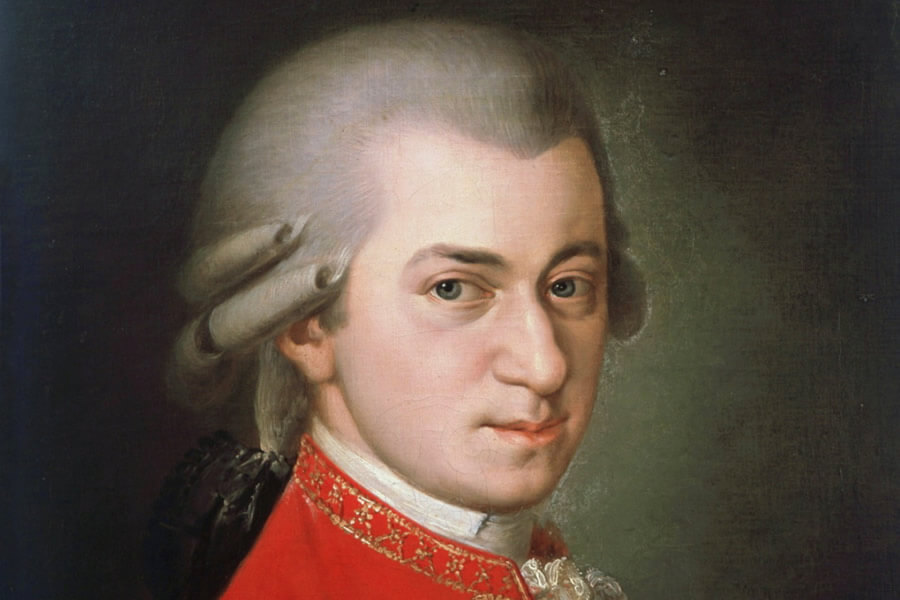
Wolfgang Amadeus Mozart was quite a character, which made him an interesting subject for a Myers-Briggs personality type analysis. I’m not going to say up front what I’m speculating for his Myers-Briggs personality type (typically referred to as MBTI type). I think this is one of those instances where I’d rather step you through my logic. I hesitated a bit, to be honest. From looking around, I got the impression that a lot of people base his personality type off of the 1984 movie, Amadeus, which is not what I did. I read parts of a biography, articles online, and etc. Any significant references will be linked to at the bottom of the article.
The typical theories for Mozart are ENFP and ESFP, with a lot of arguing between the two. I kept both in mind while researching him, and of course, tried to approach it in an unbiased to manner to form my own assessment. So with all that mind, I’ll start by discussing what I believe Mozart’s dominant function is, and the evidence I have for it, before delving into his judging axis.
Mozart, The Extraverted Perceiving Dominant
I suppose with this title, I’m cutting right to the chase and stating up front that I believe him to be an EP type. (I’m not gonna be positing any off-the-wall theories like ENTJ in this article.) So, in this section, I’ll share some general extraverted perceiving evidence before moving on to specific Ne vs. Se evidence.
1. Mozart hated being bored
He hated to be bored and, he hated to be idle. Mozart is described as someone that kept himself occupied in a variety of different way. Of course, this can apply to many personality types, but it is a common theme amongst EP types to need constant stimulation to ward off boredom.
2. Mozart was a master improviser
In-the-moment improvisation is common skill for EP types, because they’re leading very specifically with a perceiving function that is externally focused. It allows them to respond and adapt quickly to external input or stimulus without needing to internalize or call upon the judging function. Mozart is well known for his ability to musically improvise, which would his natural personality trait blending with his skill as a musician. One site I read even described him as a compulsive improviser. He would constantly and publicly play around with songs, essentially composing and/or embellishing on the fly. Bear in mind, that he wasn’t just doing this as an adult, but a young child. Improvising came naturally to him.
3. Mozart preferred freedom and autonomy
Mozart wasn’t afraid to take risks and launch out on his own. During his younger years, his father managed everything, intent on getting Mozart into a stable, money-making position. Mozart ultimately fought against this, unable to handle the confines of a “stable” position. He disliked being in service to anyone, so he got himself fired from what was considered to be a very good position, and struck out on his own. He became the equivalent of a freelancer, which allowed for a flexible lifestyle. He took on enough students to generate income, and then was able to spend the rest of his time focusing on composing what he wanted to compose and pursuing his career the way he wanted to pursue it.
4. Mozart saw planning as pointless
“That you, my son, should tell me that all planning is needless and useless, since after all we do not know what is going to happen, argues indeed a scattered brain; and you must have written that quite thoughtlessly.” – Leopold, Mozart’s father
The EP types are the least likely to value planning, preferring instead to keep their options open so that they can take advantage of opportunities as they come. For EPs, the future isn’t written; it’s an unknown to be explored. Since these types are usually spontaneous and adaptable, they often don’t feel the need to rely on detailed planning. Mozart’s father (likely an STJ, probably ISTJ) often got frustrated with Mozart’s approach to life, and this was one of the reasons.
Does Mozart Have Dominant Ne or Se?
“Even in company, there was often an air about Mozart of being in his mind not quite there.” – Mozart: The Reign of Love, pg 349
1. Mozart used too many notes, and too many ideas
“I have never yet met with any composer who had such an amazing wealth of ideas. I could almost wish he were not so lavish in using them. He leaves his hearers out of breath, for hardly has he grasped one beautiful thought, when another greater fascination dispels the first, and this goes on throughout, so that in the end it is impossible to retain any one of these beautiful melodies.” – Composer Karl Ditters about Mozart
One common complaint that Mozart received from critics and connoisseurs was that his works contained too many notes, too many ideas, and too many instruments. It was said that he was too quick to move on from one idea to the next, rather than fleshing things out. This tendency prevented him from being among the most popular opera composers of his time. Of course, this seems to be stereotypical Ne: an overabundance of ideas with a lack of focus. His father advised him to keep his music simple and pleasing, so it could appeal to the masses, but Mozart ignored him.
2. Mozart was quick to drop ideas
“When something was not going well, Mozart did not fret or labor over it; he dropped the piece and started another, even if it was a movement of a larger work.” – Mozart: The Reign of Love, pg 281
Jung describes Ne dominants as quickly and coldheartedly dropping an idea once it’s no long strikes their fancy. Basically, they don’t emotionally commit to one specific idea, making it easy to move on when something isn’t working out or when they come across a better idea. Mozart is described as being similar. As a result, he had a large number of incomplete pieces among his drafts and sketches. He would occasionally draw from these when he needed inspiration, essentially picking a random one up and completing it.
3. Mozart loved wordplay and wrote very creatively
“I am, I was, I were, I have been, I had been, I would have been, oh if I were, oh that I were, I wished to god I were, I would be, I shall be, if I should be, oh that I would be, I might have been, I shall have been, oh if I had been, oh that I had been wished to god I would have been, what? — a numbskull” (pg 246).
We have access to many of Mozart’s letters today, and from those, it’s well known that Mozart loved wordplay. He included a lot of goofy rhyming and double-meanings. The author of the book I read described him as being “a great lover of verbal gobbledygook.” This tendency is most closely associated to NPs, as they tend to make quick and creative connections between things, including their words and thoughts. But his letters didn’t just stick with wordplay. They’re full of quirky and crude content. For instance, in one, “he invents a shaggy-dog fable about a shepherd and a dog in the village of ‘Tribsterill’ where the shit runs into the sea, or Burmesquick, where they make the crooked arse-holes. The shepherd falls asleep and dreams he has lost his sheep, awakes and finds joyfully that his sheep are all there, all eleven thousand of them, and he has to get them over a bridge. Then… well, Wolfgang doesn’t known if the sheep got over the bridge and doesn’t actually care” (pg 246). Essentially, he spins a fantastical yet oddly specific tale, and then loses interest and drops it.
Is There Support for Inferior Si?
As you’ve seen seen, given all the evidence, I think the most likely type for Mozart is ENXP. I understand all the party boy stereotypes and the like that people often associate with SPs, but NPs can be like that too. I think the more compelling evidence points to ENXP. But, of course, you can’t have an dominant function, without an inferior, so is there support for inferior Si? Without repeating any of the dominant Ne evidence (because that in itself includes proof of inferior Si), here’s what I have.
1. Mozart was chronically bad with money and very impractical
Granted, some of this could apply to an ESXP as well. It’s one of the unhealthy manifestations of an extraverted perceiving dominant (Ne or Se). Basically, their money will follow their interests, and they’ll fail to think long-term, indicating a weak introverted perceiving function (Ni or Si). Mozart had money troubles even when he shouldn’t have had. But, with Mozart, it was especially bad because he was ultimately very impractical. For instance, if Mozart didn’t want to do a commission, it wouldn’t matter how badly he needed the money. He just wouldn’t do it. He also generally lacked the shrewdness necessary to make money, in spite of the fact that mediocre musicians (far inferior to himself) were managing to make their fortune. This level of impracticality could suggest inferior Si.
So, Does Mozart Use Fi/Te or Ti/Fe?
Most people immediately identify Mozart as an FP personality type, possibly due to the fact that he’s a musician. Music is known for communicating and evoking emotion. I honestly walked into this analysis not only expecting Mozart to be an FP, but wanting him to be (for the sake of variety). He’s certainly known for being somewhat emotionally turbulent, but that’s not necessarily a smoking gun. Let me show you what I found.
1. Mozart was emotionally turbulent
I know I mentioned this already, but I’m going to call it out here as a potential data point. Many sources describe him as being emotionally expressive, prone to mood swings, and moved easily to tears. This could potentially be a point towards feeler. But with that being said, everyone is emotional at their core, and expresses that emotion in one way or another.
2. Mozart didn’t express his emotional world through art
Mozart was described as master “mimic”. He often composed music with little to no actual experience or connection to what he was writing. For instance, when he initially went to write a buffa, he knew about how a buffa should go, and wrote one without stopping to study or think. The biography explained that “in his life, he would write plenty of sad music, but he did not usually compose when he himself was sad” (pg 261). His art is described as being detached from the circumstances of his life. During his time, the point of art was not express yourself, but to express everybody and art itself. This contrast appears to Fi vs. Fe. Mozart didn’t break from pattern, but stuck with “expressing everybody”, in spite of him being a brilliant composer. Of course, you could argue that he was just a product of his age, but Beethoven, who lived during the same period, broke from that, and used music as a means of self-expression. Based on this, I’d make this a point towards Mozart not being an Fi user, since he was certainly brilliant enough and stubborn to compose whatever he wanted. (Which he often did, as mentioned in earlier points – refusing to write what he didn’t want to write.)
3. Mozart adjusted his behavior based on who he interacting with
One of the things made clear by all of Mozart’s surviving letters is that he spoke completely different based on who he was talking with. His letters were consistent within themselves, but had markedly different styles and content, depending on who he was talking to. He was a different person with his father, with his mother, with his sister, with his love interest, and with the girl he was flirting with. His tone changed drastically between them. This sounds like Fe rather than Fi.
4. Mozart wrote music according to the rules of the place and genre
Partly why Mozart was such a great mimic, was because he had a intuitive understanding of the rules or framework of what he was writing. When he went to different cities, he’d adapt the rules of those locations, and write music accordingly. Mozart never felt too constricted by convention because of this approach. He would stretch and bend the rules, essentially expressing himself through it, but he knew how to work within the standard musical practices of his time. This approach strikes me as more analytical (Ti), internalizing the rules of the system and outputting a work based on them rather than prioritizing self-expression (Fi).
5. Mozart frames conflict logically rather than personally
I wasn’t entirely sure how to label this point, so just read the following example to understand. When Mozart gets offended by the Archbishop Colloredo, and is trying desperately to get out from under him, he never frames his situation anything like “I am Mozart. They can’t do this to me!” Instead, he explains what happened and what he is going to do to do fix it. That is described as being his general pattern for approaching situations: “Here’s the problem and here’s how I’m going to fix it.” This sounds more like Ti framing rather than Fi framing. Similarly, when his wife does something socially embarrassing, he writes her a long letter explaining all the reasoning and context behind what was and was not appropriate, what situations it would have been appropriate in, why he took it the way he did, and etc. This focus on logical analysis and social impact rather than personal emotional impact strikes more like Ti/Fe.
6. Mozart reflected behavior, but only to a point
“I treat people the way they treat me; — when I see that Someone is contemptuous of me and puts me down, I can be as proud as a Baboon” (pg 326).
Mozart would reflect behavior based on who he was with, but he’d also buck social convention at at a certain point, due to frustrations with how people were acting. This could potentially go towards Fi or Fe, but to me it sounds more like low Fe spite.
In Conclusion
So, as you can see, I’m positing ENTP for Mozart, which honestly shocked me. Like I said, I was expecting an EFP. Of course, I could be wrong, but I think ENTP for Mozart is where the in-depth evidence is pointing. Of course, he was a neurotic ENTP, by Big Five standards. If you have any thoughts feel free to share them in the comments!
References
Mozart: The Reign of Love by Jan Swafford
https://neurolaunch.com/mozarts-personality/
https://professionalmoron.com/2024/09/16/mozart-personality-description/
https://www.classical-music.com/features/composers/mozarts-mind
Hi there! If you enjoyed that article, leave us a quick comment to encourage us to keep writing, and check out our Updates and Current Projects. In addition, if you've found our content helpful, please consider Buying Us A Coffee to help keep this website running. Thank you!