The Myers-Briggs Type of Benjamin Franklin (ENTP)
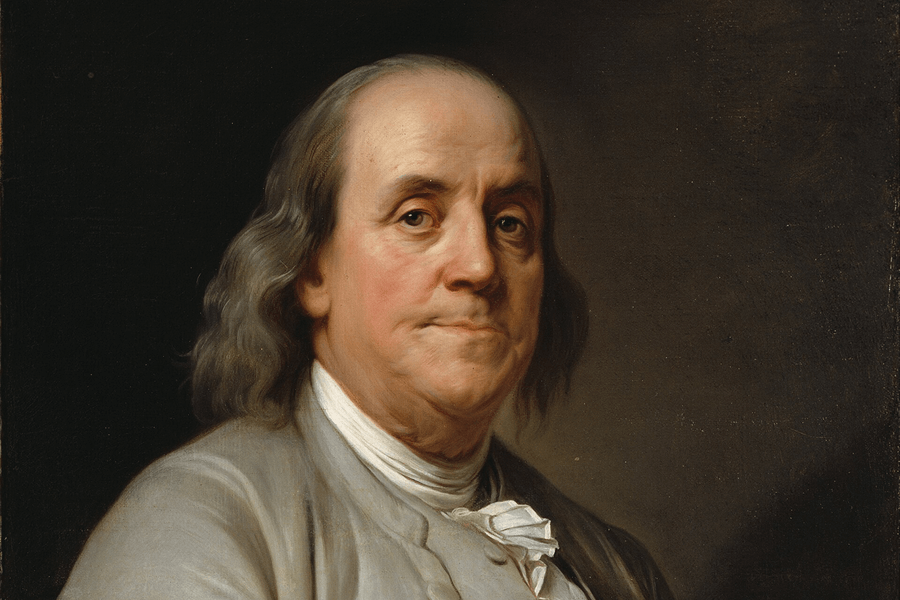
Back in December, we received a Paid Request for a personality analysis of Benjamin Franklin. It me a little longer than usual to write this article because of the holidays, but here it finally is. As per usual, I enjoyed studying Benjamin Franklin as a person, and under the lens of personality theory. He seemed reasonably straightforward, and I didn’t notice multiple prominent theories out there in regards to his personality type, so I’ll go ahead and state up front that Benjamin Franklin appears to be an ENTP. Due to this, I intend to do a simple cognitive function breakdown, and maybe add a section or two at the end for counter evidence (evidence against specific personality types). We’ll see what happens. Of course, I’ll have a References section at the bottom of the page, so you can see where I got all my information. If you make it all the way through the article, let me know what you think in the comments!
Don’t forget: when gathering evidence, it’s important to look for the big picture, what personality type seems most supported. Individual pieces of evidence can often mean multiple things, depending on context. In other words, I may mention things that are not exclusive to ENTPs, but taken as whole, ENTP for Benjamin Franklin seems to most plausible.
The Myers-Briggs Type of Benjamin Franklin
“So convenient a thing is it to be a reasonable creature, since it enables one to find or make a reason for everything one has a mind to do.” – Benjamin Franklin
Dominant Ne:
From the time he was young, Benjamin Franklin had a fascination with novelty. As a kid, he ran across someone with a whistle, which was something he’d never seen before, and spent all his money to buy it off of the individual. (His siblings mocked him incessantly, which seemed to contribute to his frugality later in life.) Innovation is often attributed to NPs, because it can be a natural extension of chasing novelty. Benjamin Franklin was certainly innovative. Of course, he’s well known for his later experimentation with lightening (the famous kite and key experiment). However, his inventiveness has a far broad scope then that. For instance, as a kid, he tinkered with how to swim faster by making himself paddles and flippers. During his later years, after he retired to dedicate time to experimentation (among other things), he invented a stove, a urinary catheter, and made a game that sounds similar to Sodoku.
Generally speaking, Benjamin Franklin loved variety. In addition to the above, he studied a wide variety of subjects, such as comets, circulation of blood, perspiration, inertia, Earth’s rotation, the Gulf Stream, meteorology, the Earth’s magnetism, refrigeration, dolphins, and etc. (to name a few). According to the author of the biography that I read, “he would begin a scientific inquiry driven by pure intellectual curiosity and then seek a practical application for it.”
However, even before his scientific experimentation phase, Benjamin Franklin dabbled in a lot of different things. His initial occupation was running a print shop, a newspaper, and writing anonymous articles. He was often coming up with and suggesting ideas for societal improvements. Throughout his life, he formed several voluntary associations, such a library, a fire squad, the American Philosophical Society, and a voluntary military force. He had aspiration not only for science, but to get into politics and diplomacy. He pursued these after his bout with science.
Benjamin Franklin loved philosophy, theoretical discussions, and debate. He explored a variety of topics and perspectives in his anonymous articles. In addition, he formed a group called Junto, for the purpose of discussing and debating. They discussed a variety of subjects. According to the book I read, “The topics discussed ranged from the social to the scientific and metaphysical. Most of them were earnest, some were quirky, and all were intriguing. Did importing indentured servants make America more prosperous? What made a piece of writing good? Why did condensation form on a cold mug? What accounted for happiness? What is wisdom? Is there a difference between knowledge and prudence? If a sovereign power deprives a citizens of his rights, is it justifiable for him to resist?”
Generally speaking, Benjamin Franklin was an individual who was always looking to move forward in life. He had an adventurous spirit, and was able to adapt quickly to circumstances. During his earlier years, prior to starting his own print shop, he headed to London with the promise from a benefactor that his trip would be covered. When he arrived at London, he found out that it wasn’t, but managed to thrive anyway. In addition, he spent much of his life traveling, and loved it.
Auxiliary Ti:
Benjamin Franklin focused on logic, rather than emotions. People often associate idealism with intuition, and there certainly can be an aspect of intuition that plays into idealism. However, thinking often grounds intuition, while feeling actually enhances idealism. Franklin had a strong emphasis on practicality, utility, and rational thinking. As the book put it, “Franklin is often described as (or accused of) being far more practical than romantic, a man of the head rather than the heart.” Franklin was not prone to “starry-eye soulful commitments” but instead developed many of his emotional attachment slowly overtime, through collaboration, partnership, camaraderie, and etc. Franklin easily made casual friends, useful connections, and attracted admirers, but wasn’t as good at developing lasting bonds that required emotional commitment. (This also points away from Fi, and supports low Fe.)
Franklin emphasized logical reasoning. He tended to be skeptical and questioning, which at times led people to described him as irreverent. Initially, Franklin’s father had plans for him to join the clergy, and sent him to Latin school. However, Franklin’s nature resulted in a certain level of rebelliousness that made his father ultimately deem him not suitable for the clergy. Although, Franklin over the years did hold religious beliefs, but he formed his beliefs around what he believed to be reasonable and to have utility. One of his early theological papers ended up being, as the book described, “strung together theological premises with logical syllogisms to get himself quite tangled up.” This sounds like the relative nature of Ti, failing to ground to something external. In later years, Franklin focused more on empirical evidence, being uninterested in theological questions that weren’t based in such. He is described as being suited for the Age of Reason, rather than the Romantic era that started rising in Europe and America in the later years of his life. (The sentimental subjectivity of the Romantic era having little appeal for him.)
In the section on dominant Ne, I covered Franklin’s enjoyment of philosophical discussion. His Ti can also be seen at play in those discussions, in his desire to reason everything out. During his phase with Junto, Franklin was focused more on polite/calm discussion, striving to adhere to principles of the Socratic method, but earlier on he was much more prone towards debate. He tended be contentious and confrontational. At times, he’d even take stances purely for the sake of debate rather than out of conviction. As he put it, “I took the contrary side… perhaps a little for dispute sake.” However, Franklin learned that the “humbler enquirer” style of arguing in the Socratic method was more effective. Franklin would ask seemingly innocent and sometimes tangential questions that eventually exposed someone’s logical fallacies.
As a general rule, Franklin wasn’t really interested in entertaining the absurd, but rather focused on subjects that held practical value to himself or to society. However, (something that struck me as very ENTP), when he was younger, Franklin started a sect with a friend, where the friend produced odd doctrine such as never trimming one’s beard, and Franklin was the one in charge of defending it. (He agreed to this so long as vegetarianism was included in the doctrine.) It lasted about three months until his friend broke the vegetarian rule.
Franklin seemed to excel at entertaining multiple perspectives, or rationalizing both sides of something, which is common for Ti users, because it’s easy for them to detach and play with logic to see what makes the most sense. Many of his anonymous articles would rationalize viewpoints from different perspectives or put forward controversial takes on a subject. In addition, many of his writing were impersonal in the sense that they were written as some fictional character that he’d invented. In other words, he rarely wrote using his own voice, which suggests a certain level of de-personalization or detachment that supports Ti.
Tertiary Fe:
Benjamin Franklin had a charming and magnetic personality. He was good at attracting people to help him and winning people over. When he wanted to, Franklin could even be flirty and flattering. He tended to form a lot of social connections because of this, albeit many being more shallow in nature or based on utility, as referenced in the Ti section. His emotional connections being formed slowly out of collaboration and camaraderie generally supports Fe. In addition, Franklin valued social networking, which is part of the reason he formed his group, Junto. While a major purpose of the group was philosophical discussion, Junto was also intended for networking so that people could further their careers.
Franklin was very careful to nurture his reputation. (If you’re into Enneagram, this guy is a 3.) Part of what attracted him to the Socratic method of debating is that it proved safer for him and very embarrassing for those he used it against. In addition, it made him seem less confrontational and more endearing. However, some people actually viewed him as manipulative and conniving. As he matured further into his gentler style of discussing thing, Franklin would for the most part actively avoid outright disputing, unless it was necessary. He would even encourage others to do so as well, and found himself in the role of mediator. An example of this can be seen in his dealing with Governor Robert Hunter Morris, when he encourages him not to dispute with the Assembly, and ends up playing the role of mediator when the governor ignores him.
Franklin focused heavily on social reform and improving society. I mentioned in the dominant Ne section some of the various ways in which he strove to improve society. In addition, he used his paper as a way to influence others. Franklin was also focused on how to interact properly with others, to encourage harmony, which can be seen in his rules for Junto (to discourage debates) and in his newspaper piece called “On Conversation” where he discussed conversational sins. As his career escalated into politics, Franklin eventually become the country’s first public relations expert.
As a manifestation of lower Fe, Franklin also implies (according to the book’s author) that “most people act virtuously not because of an inner goodness but because they are afraid of public censure.” This shows an awareness of how social pressure influences and impacts others, in addition to demonstrating the cynical nature of Ti.
Inferior Si:
Franklin’s spontaneous, and extraverted perceiving nature, did create occasional problems for him, such as heading off to England without guaranteeing that he had the financial details worked out. He also struggled greatly with tasks that he deemed to be mindless, such as candle-making. (He had to work in his father’s candle and soap shop as a child.) During that time, Franklin expressed a desire to go to sea, which scared his father into finding him more interesting work.
Franklin didn’t consider himself to be very ordered. He briefly tried to work on becoming more orderly, but eventually decided that he was busy and had a good enough memory that it wasn’t necessary for him. This could indicate a couple of things, but it’s common for inferior Si users to struggle with consistency and organization, due to the emphasis on novelty and change. At one point, he lamented that he had never outlined a design for how he should conduct himself (because his life has been somewhat confused so far), and started writing pragmatic rules for success and self-improvement guides.
Generally speaking, Franklin was someone who was constantly on the move, and didn’t live a life that one would consider stable or consistent. Franklin was constantly exploring new things, and seeking new heights. For instance, while he seemed to care about his wife greatly, he spent 15 years out of the last 17 years of her life without her, traveling abroad.
Franklin could be a stickler for the details, when something mattered to him, which shows an emphasis on Si. (Lowers Si users get this way as well as higher Si users. For lower Si users, that detail-oriented nature is less consistent, having a narrower scope.) When Franklin wrote up plans, such as for the volunteer fire company, he described the duties and operations in great detail. He approached the plan for the Militia Association in a similar fashion. And for my last example, he wrote a drinker’s dictionary for the newspaper, listing 250 or so synonyms for being drunk.
What About ESTJ?
“In truth, I found myself incorrigible with respect to Order; and now I am grown old, and my memory bad, I feel very sensibly the want of it.”
“My scheme of Order gave me the most trouble;[70] and I found that, tho’ it might be practicable where a man’s business was such as to leave him the disposition of his time, that of a journeyman printer, for instance, it was not possible to be exactly observed by a master, who must mix with the world, and often receive people of business at their own hours. Order, too, with regard to places for things, papers, etc., I found extreamly difficult to acquire. I had not been early accustomed to it, and, having an exceeding good memory, I was not so sensible of the inconvenience attending want of method.”
I did see the odd ESTJ theory on Benjamin Franklin, likely due to his emphasis on productivity, pragmatism, and industriousness. Franklin was certainly ambitious. The longer I read the book, the more ESTJ he actually seemed to me, but that indicates development. The dominant Ne theme throughout his life is strong. I would expect an ESTJ to have a greater emphasis on consistency and stability, and most of all, to not struggle with order. Benjamin Franklin saw order as his weak link, which is why he gave up on that virtue quickly and decided it was unnecessary for him. In one of the quotes above, he essentially describes himself as not being methodical because he had a good enough memory to make it unnecessary.
References
https://www.gutenberg.org/files/20203/20203-h/20203-h.htm
Benjamin Franklin: An American Life

Hi there! If you enjoyed that article, leave us a quick comment to encourage us to keep writing, and check out our Updates and Current Projects. In addition, if you've found our content helpful, please consider Buying Us A Coffee to help keep this website running. Thank you!
I knew it!
I think comparing this to Einstein’s article might be a good reference point for Tert. Fe vs. Inferior, even if the lower Fe user has a certain level of charisma. I guess going by personal experience, as an Inf. Fe user (INTP) I don’t know if I would have tried to so hard to stop debates in Junto. I’d probably be more of the Uraraka mindset: “Yeah, but it’s kinda fun listening to them fight.” haha (Though, I guess it’s not impossible for an ENTP to feel that way, too.)
“Benjamin Franklin saw order as his weak link, which is why he gave up on that virtue quickly and decided it was unnecessary for him.” This kind of reminds me of how some Inf. Fe users feel hopeless at adapting to social situations or people and may build up a tendency to avoid them altogether. I wonder if this applies to other inferior functions?
“I did see the odd ESTJ theory on Benjamin Franklin, likely due to his emphasis on productivity, pragmatism, and industriousness. Franklin was certainly ambitious. The longer I read the book, the more ESTJ he actually seemed to me, but that indicates development.”
Does that mean an INTP who emphasized those things could be mistaken for an ISTJ in some contexts? Hmm… I kind of thought a developed type would start to resemble an XSFJ more and more but I guess people are different!
Thanks for the article! I enjoyed reading it once again!
Theoretically, ideal development for an ENTP would be toward ESFJ. But, that doesn’t always happen perfectly. He definitely did develop his Fe as he got older though, but the “thinker” still shined through pretty strongly. It’s possible that if I’d started reading about him later in life, maybe I’d have considered ESFJ, but my mind had locked in on thinker after reading about younger him, that I never really had ESFJ cross my mind.
Ohh, ESFJ! That’s so interesting. I guess that would mean ideal development for me would be toward ISFJ. I kind of want to put in a paid request for an SFJ significant figure so I can understand how someone with Si and Fe as their higher functions approaches life with their different strengths and maybe use it as ideas for how to develop my lower functions. (I guess a good fictional example of this would be how Destiny[Cosette] from Takt Op. Destiny who I think is an INTP looked up to “Big Sis” Anna, who’s an ESFJ, as a role model and maybe sort of a guide on “how to be human”, hahaha.) I can’t really think of any SFJs off the top of my head, though, so I’ll maybe try to find one.
I also wanted to put in a paid request for Magnus Carlsen first since I thought it might help me learn more about Se and how Ti operates completely separated from Ne. (I have trouble knowing where one begins and the other ends in my thought processes sometimes. 🫠) Plus… well, I thought of doing this first. Better to do things in order like this or it’s going to get confusing, haha.
Ideal would be your reverse stack, so ESFJ for INTP, but realistically, ISFJ is more achievable and likely. It would be far more difficult to make your inferior function look dominant than it would be to just shift 3rd and 4th up together.
Email in the paid request when you’re ready and I’ll see if there’s enough on him.
Need more like this!
Thanks! That’s my goal.