The Myers-Briggs Type of Martin Fleischmann
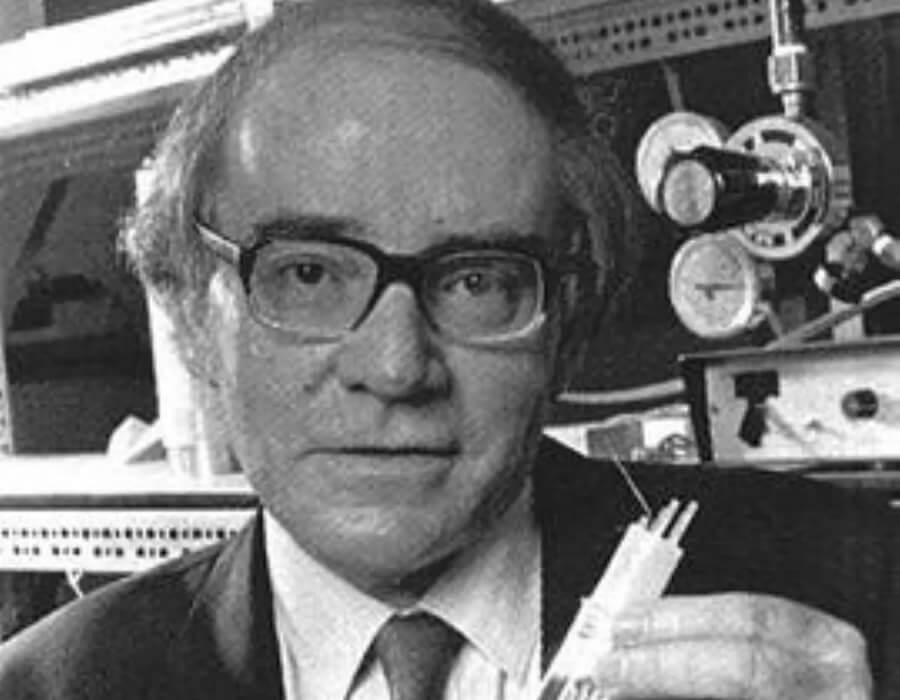
You may or may not have heard of Martin Fleischmann, but his name came up while I was trying to determine whether Albert Einstein was an ENTP or INTP. At the time, I was expressing a need to contrast Einstein with someone who was definitely an Ne dominant, since it was being suggested that Einstein’s drive to understand the universe meant dominant Ti. But, isn’t that every scientist’s goal? At least, that was the question I asked. So, what would Ti lead in a scientist look like versus Ne lead? That’s when a fellow typology enthusiast mentioned Martin Fleischmann’s name as a potential solution to my dilemma.
It only took a few minutes of looking into this Martin Fleischmann to see the obvious dominant Ne. Unfortunately, I wasn’t able to find a lot of information on him, so I wasn’t able to determine his judging axis to any degree of certainty. Therefore, I’m just going to leave out that part, and use Martin Fleischmann to demonstrate what dominant Ne can look like in a scientist. It would be a shame to lose this example simply because I can’t pin down his personality type exactly. If you happen to have a source that demonstrates his judging axis well, feel free to share in the comments.
The Myers-Briggs Type of Martin Fleischmann
“If it had been anything else, we would have said, ‘People don’t want us to do it. Forget it. Let’s just leave it alone.’ But this is not in that category. This is interesting science. New science. With a hint of a possibility of a very useful technology. Therefore, if you’ve got any integrity, you don’t give up. You only give up if you find you are wrong. But as long as you believe that you are right, you have to continue. And you have to take the consequences.” – Martin Fleischmann
To be clear, dominant Ne means that Martin Fleischmann is either an ENFP or an ENTP. I’m not going to assume that he’s an ENTP simply because he’s a scientist. That would be stereotyping at it’s finest. I know ENFPs who are technical, just as I know ENTPs who lean creative. There must be solid evidence to support conclusions, and I wasn’t able to find enough evidence either way for Martin Fleischmann’s judging axis.
Dominant Ne in Martin Fleischmann
“When the discussions with the visitors began taking too much of my time, I would call on Martin Fleischmann and see if he had time to meet these people. After stating the subject which they wanted to talk about, I would retreat to my desk and continue my work. The story was the same for all of them. It was impressive how often Martin conjured up some theoretical hypothesis to meet the type of result that they were trying to expand on. Of course, the level at which Fleischmann would present his ideas was a rather high one and sometimes involved beginning with a second order differential equation and some applications of Fick’s law. It took about five minutes for the visitors to think that they had no place in this and make an excuse for catching the earlier train.” – Bockris recalls
“Both Martin and Pat were innovative scientists, enjoyed competing with each other in scientific brainstorming, and were excited by the prospect of audacious experiments. I well remember those sessions when ideas were flying.” – James McQuillan
There are two main things that stand out about Martin Fleischmann (as it pertains to personality theory). The first is that he was a man with many ideas. In other words, coming up with ideas was Martin Fleischmann’s strength. He was known for it. For instance, when appointed to a postdoctoral research fellowship at Durham University, he was noted for being innovative and described as being a “brilliant contributor with an oft-demonstrated flair for new ideas”. He excelled at real-time brainstorming, coming up with ideas on the fly, and finding new approaches to things. He seemed to get a rush from new ideas, wanting to share them immediately with whoever he could. In one recollection, Martin is described as interrupting someone’s classroom lecture, proclaiming that he’d had an idea. He rushed in, accidentally spilled his coffee, erased the board, and began furiously writing on it. The immediate need to discuss and share the novel ideas (getting a rush from them) is characteristic of an Ne dominant.
However, Martin wasn’t content just to leave an idea in the theoretical realm, which leads us to the second thing that stood out about him. Martin appeared to have a propensity for experimentation, essentially testing out his ideas or turning them into experiments (as the article I read stated). James McQuillan, who worked with Martin for a time, describes him as an innovative scientist, “excited by the prospect of audacious experiments.” This is a key different between auxiliary Ne and dominant Ne. Dominant Ne is driven to experiment in the real world, in order to discover the possibilities or the potential. (In comparison, Einstein did a lot of this in his head which were described as thought experiments, pointing to a subjective or introverted function lead).
Thoughts on Inferior Si
After reading the controversy around cold fusion, there were a few things that stood out to me. There seemed to be a lot of complaints regarding the lack of details provided to replicate his experiment. Many people believed him to be a brilliant scientist and didn’t believe he was just faking the whole thing. However, they had to derive the measurements of certain tools from pictures, and things of that nature, as if Martin and his partner hadn’t actually documented all the relevant details to replicate their experiment. In addition, it was also noted that he didn’t follow proper procedure in the way he went public and presented his findings. It sounded as if it was all rushed, which ultimately blew up in his face. This all strikes like inferior Si weakness – disregarding details and failing to perceiving long term consequences.
A Brief Thought on Martin Fleischmann’s Judging Axis
I know I said I was going to avoid this completely, but there is one thing that stood to me that was potentially relevant to his judging axis. Martin briefly served as president of the International Society for Electrochemistry. It was noted that he was not a natural administrator, in addition to being extremely disorganized. His office became a sinkhole for documents, reports, etc. It was always filled with stacks of papers that he never got to. Derek Pletcher explained: “if your interest dropped below a certain level you were wise to sneak in and return it to the top of the pile. His secretary, Kate, had a system where piles were regularly moved to a box in a cupboard and then destroyed if MF had not noticed in 2 years!” He also used to tease Martin, by saying, “The only thing that you do efficiently is to book your skiing holidays.” Apparently, the role stressed Martin out considerably, and he retired from it after only a couple of years.
All of this could suggest an entire lack of Te in Martin’s cognitive function stack, since Te values efficiency and organization. It doesn’t appear that Martin put any effort at all into those things which would indicate ENTP rather than ENFP. However, it is possible that an ENFP could have very underdeveloped Te as well, so I don’t feel comfortable taking a hard stance on this.
References
Hi there! If you enjoyed that article, leave us a quick comment to encourage us to keep writing, and check out our Updates and Current Projects. In addition, if you've found our content helpful, please consider Buying Us A Coffee to help keep this website running. Thank you!
I think he could be ENTP because he had a need to share and prove his ideas to others. In fact he was often called to deal with other people.(FE) he wasn’t necessarily trying to be emotional soothing caregivers as his idea of connection to others was through ideas(Ne) and logic(Ti)
also I think he isn’t ENFP because he wasn’t trying to build up or enforce his image as a trustworthy or genius scientist (Fi) but rather have fun enjoying his ideas with others.
But then again this just my theory.
Oh, it makes so much sense for an Extraverted Ne dom scientist to prioritize doing experiments and generally interacting with the outside world in contrast to the Introverted Aux. Ne Einstein who kept it more internal with his thought experiments!
I remember an INTJ MBTI YouTuber made a video on INTPs and she seemed… slightly disappointed(?) that a lot of the INTPs she knew didn’t seem to use their Ne a lot (or at least in ways visible to the outside world… she mentioned using it to look up topics and research which she called “the most introverted way possible to use your extravert function” or something like that and her tone kind of sounded like “that doesn’t really count”) and she encouraged us to go out and do stuff with it more, saying she’s sure that whatever we use it for will be interesting. I also heard lots of horror stories about Ti-Si looping and how Ne use can save you from that when I first started getting into MBTI. All this to say… if I seem to have a more active (or external) than usual Ne for an INTP it’s probably due to a combination of encouragement from that YouTuber and purposefully trying to use it more to avoid looping, hahaha.
What interesting the most is that in most talks about the Aux despite being the next developed Function other people tend to often encourages development of the aux in the proper extroverted or introverted way. And with the tetirary is often considered somehow a lot easier to access even though it’s so far away from the dom.
I tending to see also that the way MBTI is build although it can help with explaining behavior it doesn’t give the inner world that much justice. In fact I’m beginning to see that looping or being in the grip although real and damaging doesn’t mean that all usage of Xi-Xi/Xe-Xe isn’t always going to be looping or gripping it’s only when you can’t easily break out of it that it’s harmful.